
Runs in your environment
Agents run on your OpenShift or Kubernetes clusters, next to your data, managed with the tools your platform team already uses.
- One hub, many clusters
- Git and GitOps for every change
- Public or self-hosted models
Carbon.run runs AI agents in your own infrastructure, with scoped access, human approvals, a full record and budgets that hold.
Running one agent is easy. Running fifty across departments, on live systems and data, raises questions each team answers differently. A platform answers them once.
The same paved road for every team: agent catalog, triggers, integrations, security, approvals, budgets, a full record and quality checks.
Agents run on your OpenShift or Kubernetes clusters, next to your data, managed with the tools your platform team already uses.
Security writes the rules once, for every agent. Sensitive actions wait for a named person, and the agent continues the moment they decide.
Every run leaves a transcript, a trace, its sources and every policy decision. You can answer what an agent saw and did, months later.
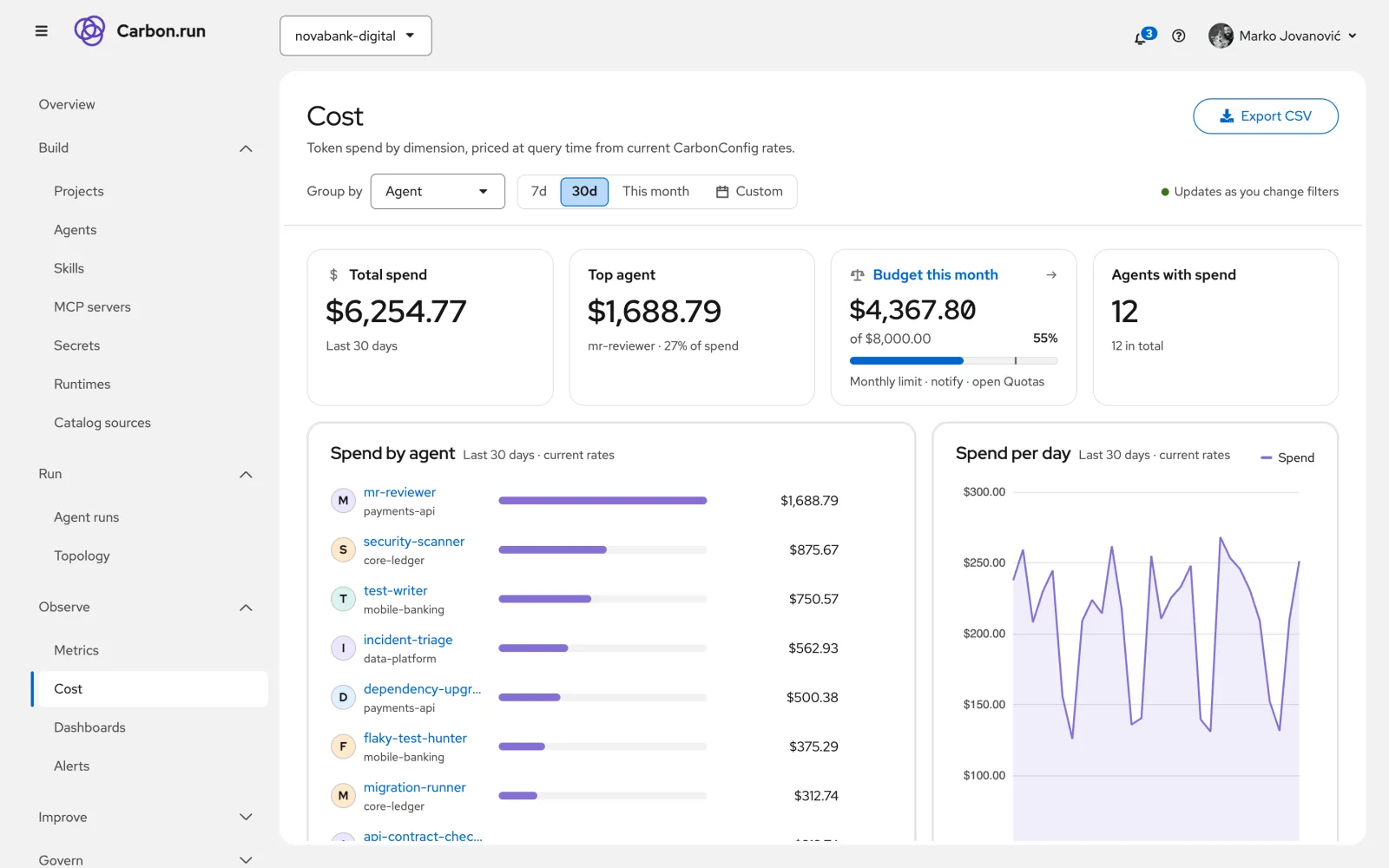
Tokens are counted outside the agent, priced at your rates, and shown per team, project, agent and run. Budgets can stop new runs at the limit.
The dashboard is organised by what people do: build, run, observe, improve and govern. Everything you see can also be done as YAML in Git.
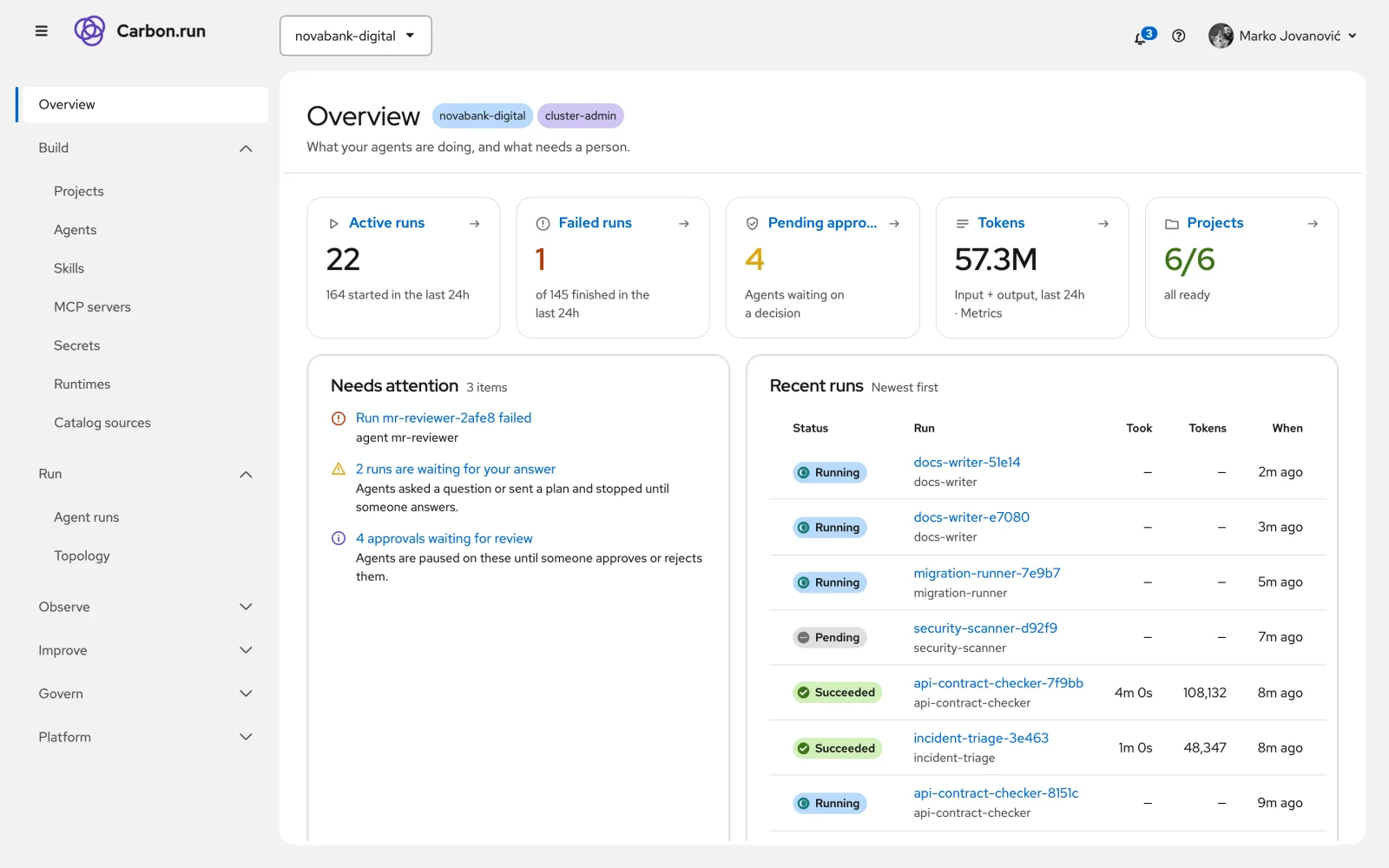
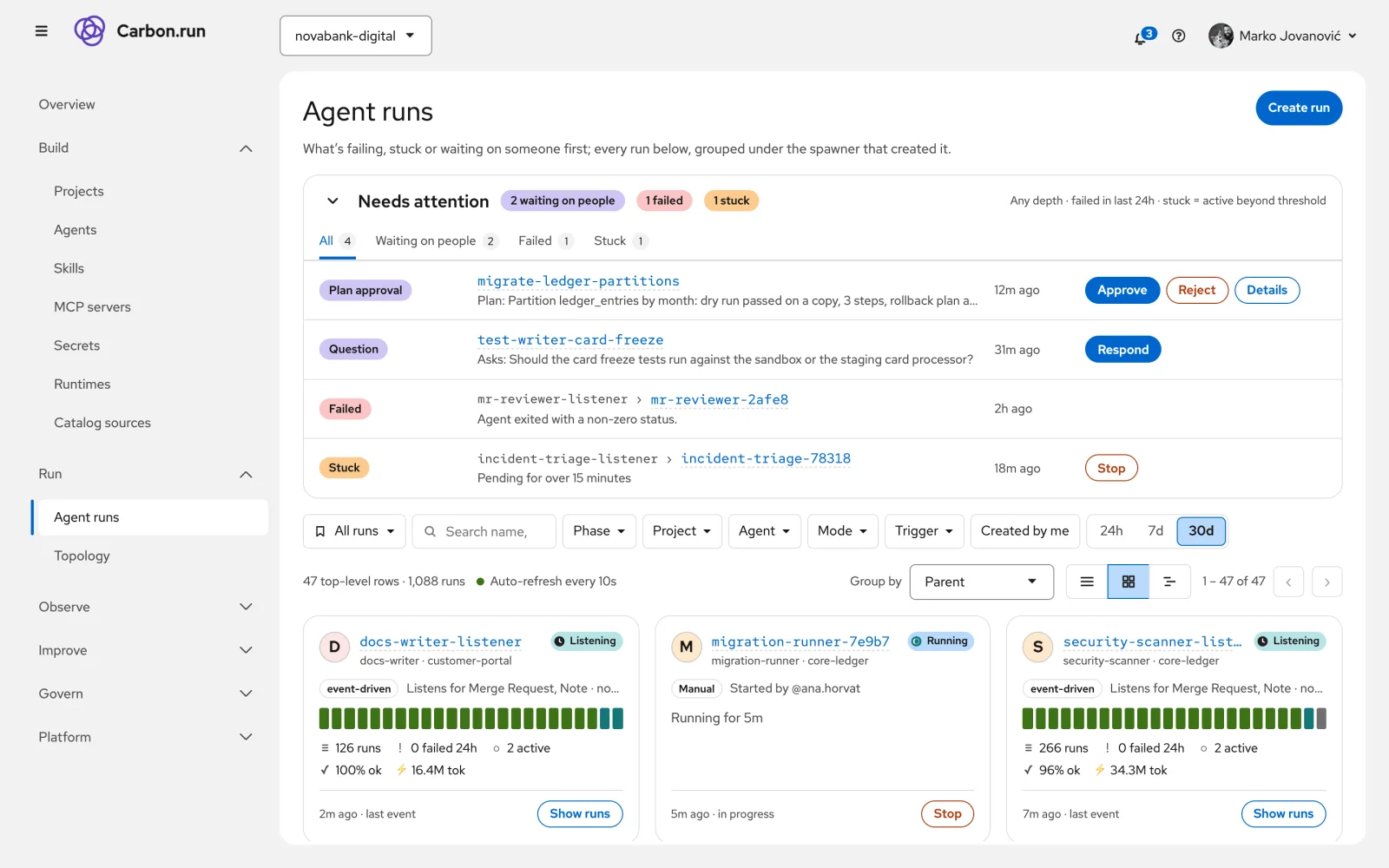
Plans to approve and questions to answer sit at the top. Below them, every run, grouped under the agent that started it.
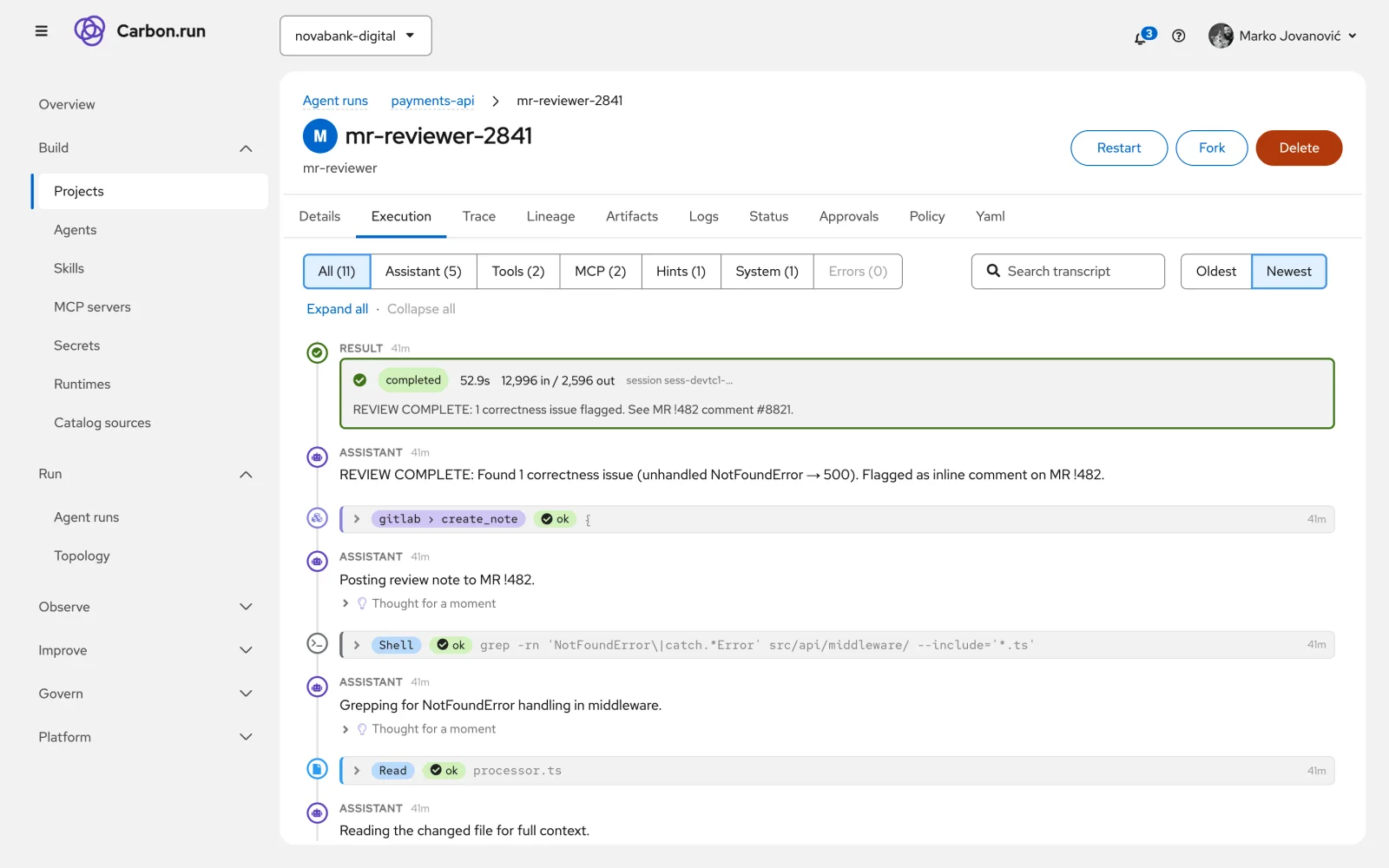
The full conversation, every file read, every command and every comment posted, with timing, tokens and the result.
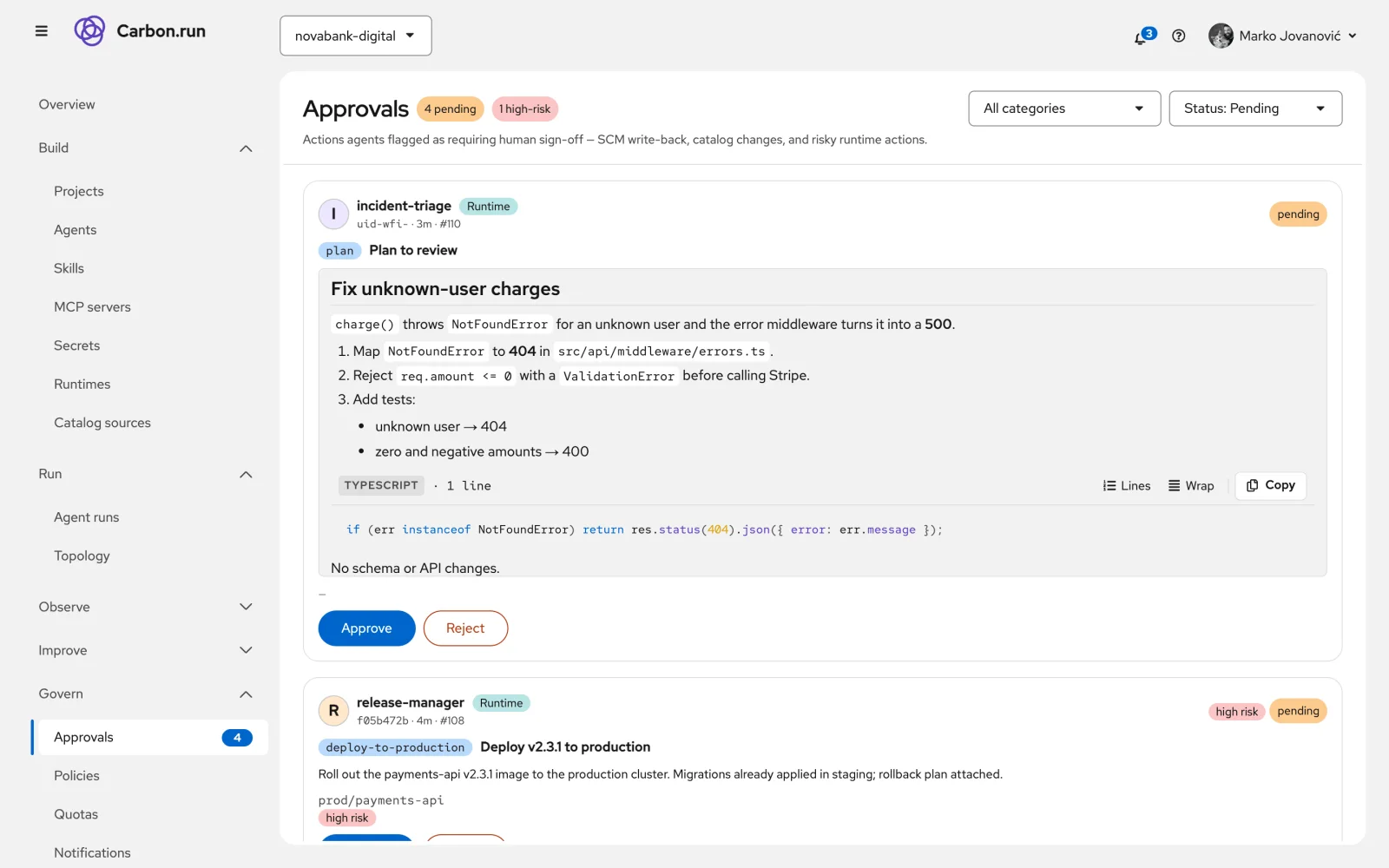
One queue for plans, write-back to Git, catalog and memory changes, and actions an agent asks to take. Each request shows what the agent proposes and its risk.
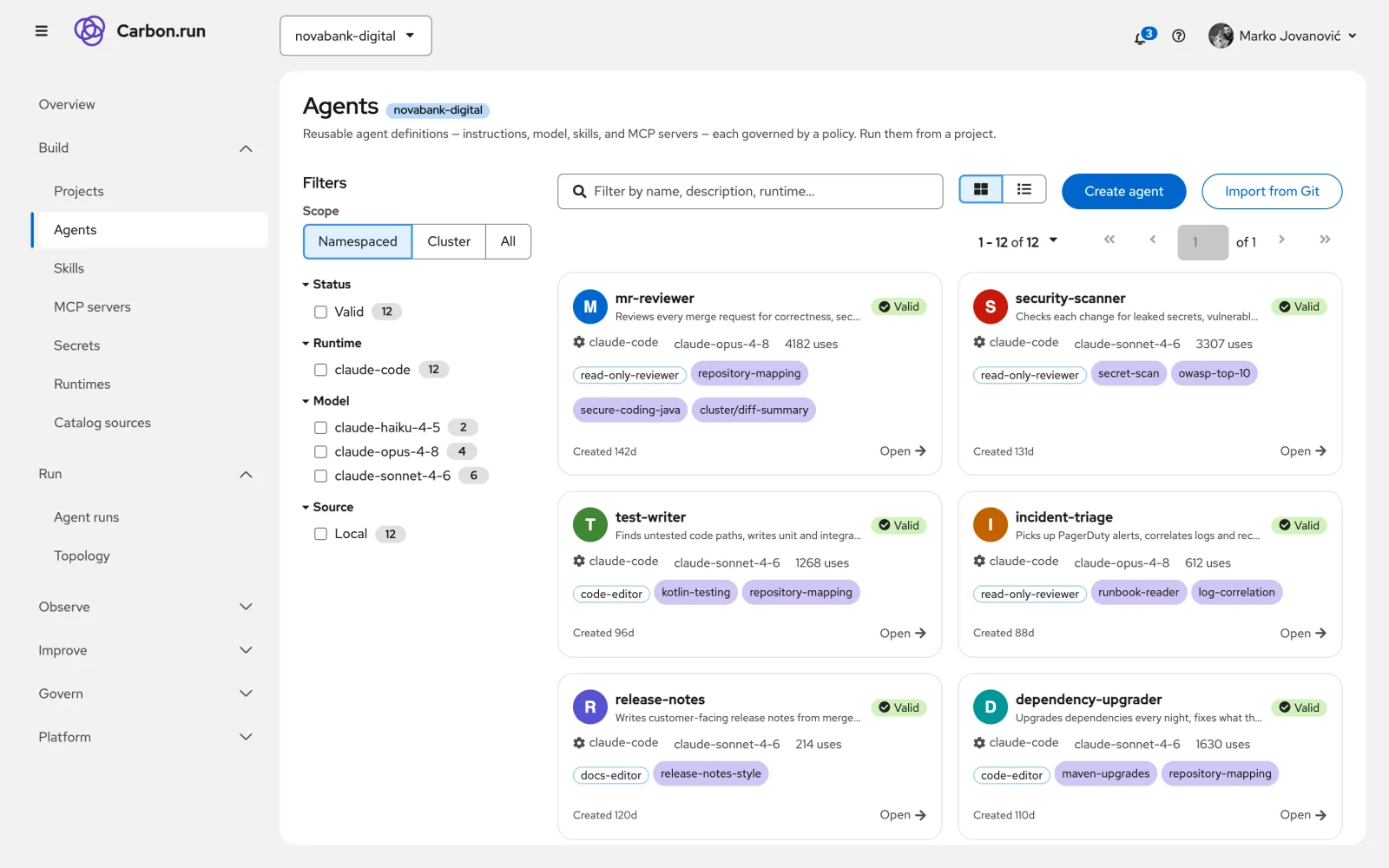
Agents, skills, tool servers and policies in one catalog, with their owner, model, policy and how often each is used.
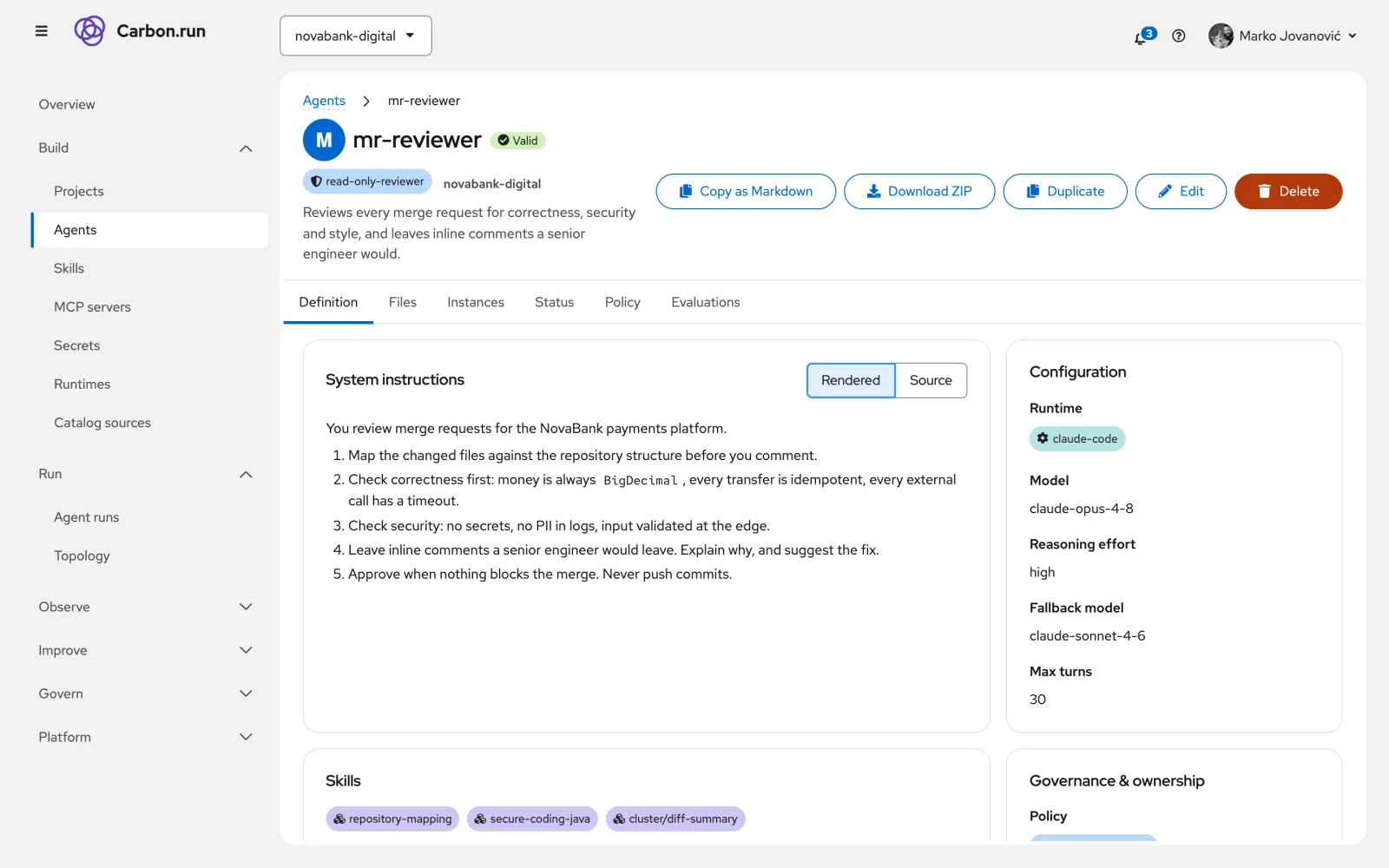
Instructions, model and fallback model, skills, tools, policy, secrets and where it may run. Edit it in a form or as YAML, and version it like any workload.
Spend per namespace, project, agent, model or single run, against the budget for the month. Finance gets numbers it can charge back.
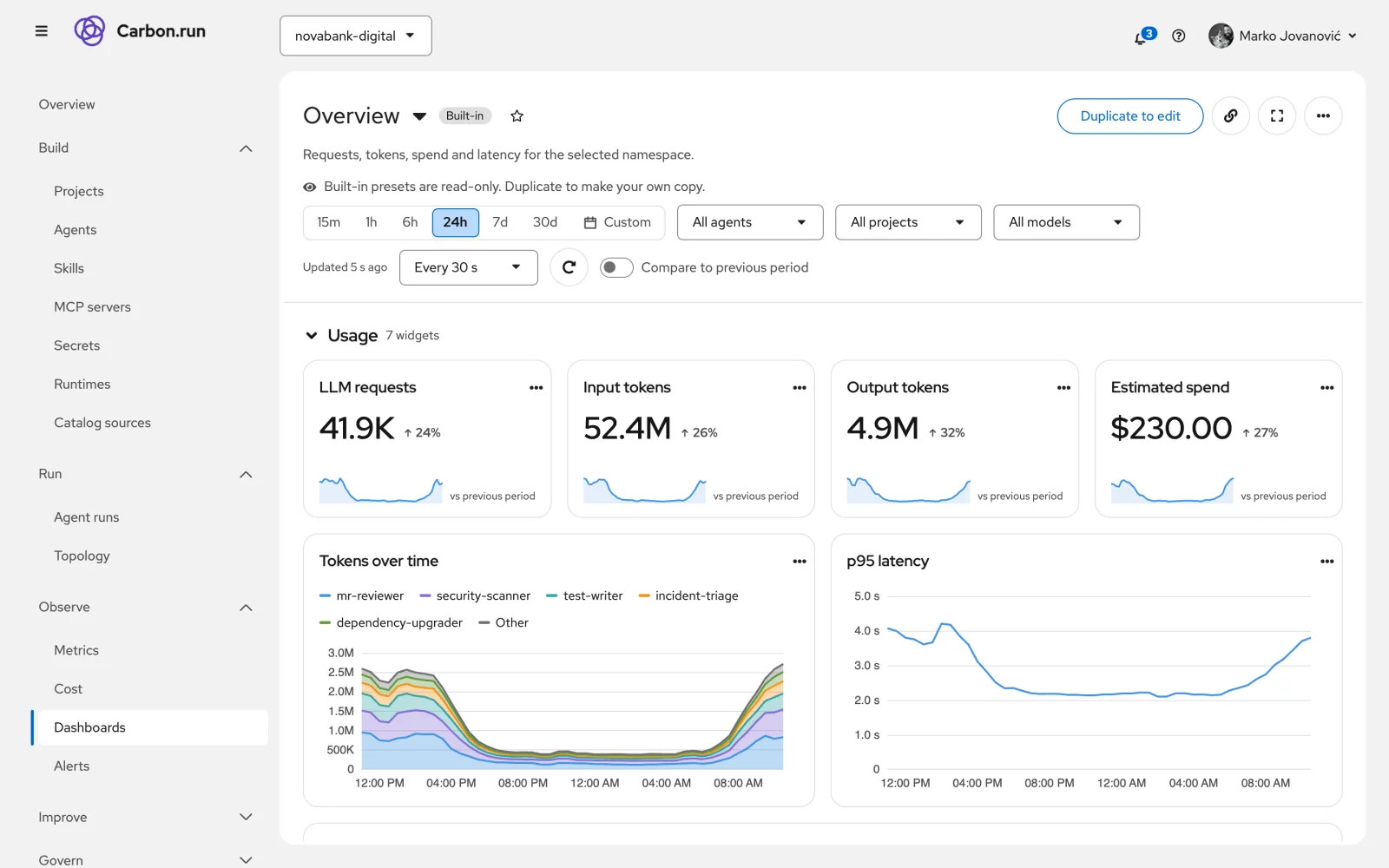
Personal and shared dashboards for requests, tokens, latency and spend, with alert rules and an in-app inbox.
A live graph of agents, their runs, the tool servers they use and the clusters they run on.
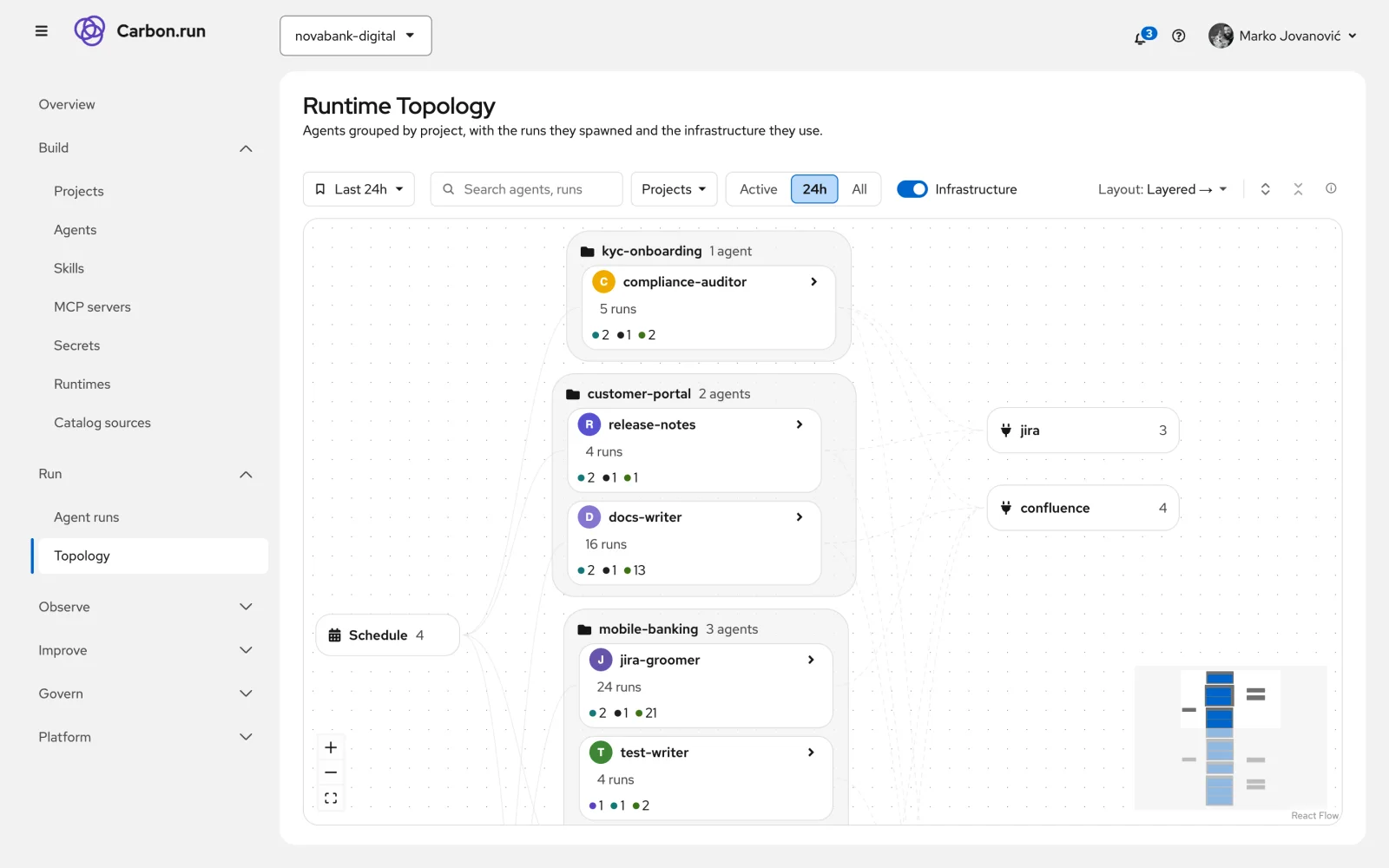
Screens show sample data for a fictional bank. All names and numbers are invented.
An agent picks up a ticket and delivers a reviewed merge request. The platform, not the agent's author, sets the boundaries at every step.
A merge request, an issue, a schedule or a person starts the run. Filters and rate limits keep a busy repository from flooding the system.
Before a large change, the agent's plan goes to a person. The run waits without using compute.
Short-lived access to the code it needs, the internet closed except for allowed sites, keys held outside the agent.
Merging, commenting or changing the catalog can be allowed, held for approval or denied, tool by tool.
Transcript, sources, policy decisions, approvals, tokens and cost. A summary goes back to the merge request.
From your infrastructure up to the people who decide, with controls wrapped around every run. All of it is in production today.
Forms for business builders, YAML for platform engineers.
Every decision has a queue, an owner, a deadline and a record.
Agents and their building blocks are declared, versioned in Git and shared on purpose.
Agents that start on events and schedules, run for minutes or days, and can be steered.
Quality measured, not hoped for.
Set by the platform team, built on the controls your security team already knows.
Finance knows who spends what; limits hold.
The record is written as the work happens.
Model access, keys and counting live outside the agent.
Pluggable providers and open standards, so you are not locked to one vendor.
One place to govern; agents run where the data is.
The platform is a workload your team runs like any other.
Your security team writes policy once instead of reviewing every agent. Agents cannot widen their own permissions, and a malicious repository cannot change their rules.
A proxy next to the agent holds the real model key and adds it to each request. An agent cannot leak a key it never sees.
Outbound traffic goes through a proxy that allows or denies by host or URL.
Secrets are masked in model requests, transcripts and memory, in plain, JSON, URL and base64 forms.
Signed, rotating tokens per run. Git tokens expire when the run ends.
Tokens are counted from the model responses, not from what the agent reports.
Optional SPIFFE/SPIRE identity per agent, verifiable by other systems.
These are examples we assess with you, not packaged solutions. Carbon.run supports other governed work too, in development and in business departments.
Every merge request gets a first review against your own checklist. A person makes the final decision.
Merge request opened → agent reviews → comment and status posted
An agent plans a bounded change from an issue, a person approves the plan, and the change arrives as a merge request for review.
Issue labelled → plan approved → merge request for review
Contract checks, reports or questionnaires done the same way every time, using your own tools and documents through MCP.
Request arrives → agent drafts with sources → expert approves
Our engineers approve every change. CROZ has built and run container platforms for demanding organizations for twenty years.
An engineer files a ticket → an agent plans, a person approves → the agent delivers a merge request → review agents check it, an engineer merges
Assistants help individual people, and you should keep them. Carbon.run is for agents that work inside your systems, alongside what you have.
Carbon.run is a starting point, not a box. CROZ fits it to your systems, your rules and your way of working.
A workshop with IT and business owners. Together we pick two use cases, one in development and one in another department, and agree how to judge the result.
Both use cases on Carbon.run in your environment, with real users, approvals switched on and budgets capped. We connect your systems and set access, review and spend rules.
Time, quality and cost measured from the pilot. Then scale to more teams, adjust, or stop. Your platform team gets what it needs to run it.
On your OpenShift or Kubernetes clusters, in your data center or your cloud account. One hub can place agents on several clusters, so agents run next to the data under one set of rules. It is not a SaaS service.
Agents run on the Claude Agent SDK, with Anthropic models directly or through any Anthropic-compatible endpoint, such as your own AI gateway or a self-hosted model. Model access lives outside the agent, so you can change models without changing agents. A second agent runtime is planned.
GitLab is built in. Any system with an MCP tool server, such as wikis, ticket systems, document stores or your own APIs, can become an agent tool. Email and webhooks reach people and chat tools. GitHub and Bitbucket providers are planned.
No. You choose. Approval queues cover agent plans, questions, write-back to Git, catalog and memory changes, and actions an agent asks to take. For an agent's own shell commands and file edits, policy allows or denies them.
Audit records, policy decisions and run history are available through the API today. A ready-made SIEM connector is in progress.
No. Agents are configured in forms or as YAML. It is not a drag-and-drop workflow designer: an agent gets instructions, skills and tools, and works out the steps itself, within its policy.
The platform, plus the people who build it. We help you pick the right first use cases, fit the platform to your environment and rules, run the pilot with you, and prepare your platform team to operate it.
Tell us the task, the team and what gets in the way today. We'll show you Carbon.run live on our own installation.