TL;DR – We noticed that BMAD and similar frameworks run out of breath along The Spectrum, which is why we developed the Carbon.modernize approach to politely step in and give you a nudge in more complex scenarios.
Over the past few months, I’ve had many conversations about AI-assisted development, and each one came from a different perspective.
“Yes, but we’re building a brand-new piece of software…”
“Yes, but we already have an existing system that’s 15 years old, and we must build on top of it, there is no way around it…”
“Yes, but we don’t actually build any new features. This is pure refactoring and modernization of an existing legacy system…”
So, how do you come up with a single AI-assisted methodology to cover all these cases? You already know the answer: there isn’t one. And in today’s 0800-DEVOPS, I’m sharing the approach that we at CROZ took to tackle this issue.
From greenfield development to legacy modernization
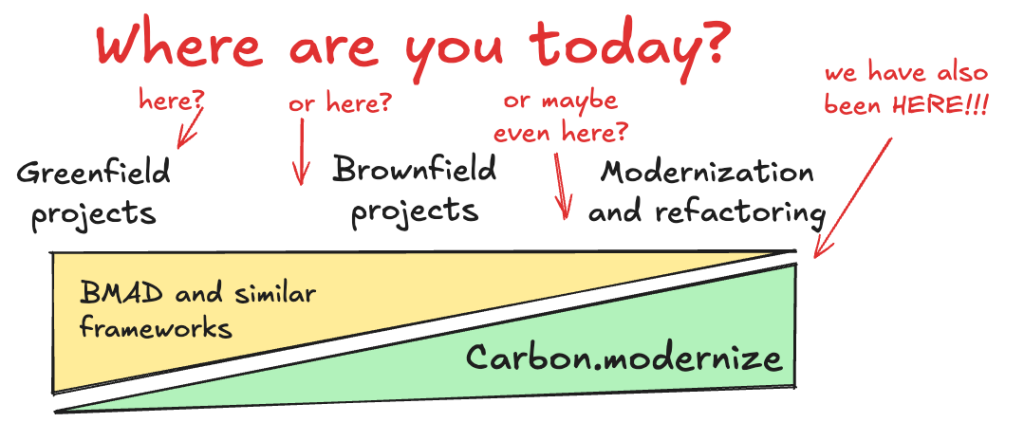
In our experience, there’s The Spectrum of development projects.
All the way to the left are greenfield projects. They start from scratch, no legacy, no baggage, sky’s the limit. Frameworks such as BMAD fit well here.
A Little further to the right are brownfield projects. They start with an existing system that gets modified as new features are added. The existing system can’t be thrown away, even though documentation for it is mostly nonexistent and nobody really knows how they work.
All the way to the right are pure modernization and refactoring projects. No new functionality is considered. It’s all about optimizing and modernizing the existing implementation.
This isn’t a spectrum with just three distinct states, but rather a continuum along which there are countless different cases and circumstances.
Most modern frameworks, such as BMAD, address the left-hand side of The Spectrum — projects that are completely or mostly greenfield. Rarely does anyone address the right-hand side, and should we blame them for that? The right-hand side is dirty, messy, full of constraints, sometimes a minefield. Are you old enough to remember Minesweeper?
As a BizTech consultancy, we don’t ignore the fact that these messy systems represent the biggest challenge for our clients. That’s why we developed and battle-tested a methodology that gradually assists dev teams as they move along The Spectrum toward the right-hand side. It’s called Carbon.modernize.
Carbon.modernize is a comprehensive suite of tools and practices that helps development teams get familiar with undocumented legacy systems and apply agentic force to refactor and modernize them. It’s not an all-or-nothing suite, but rather a collection of tools and practices where you pick and choose the right tool for the job.
How Carbon.modernize supports modernization projects
If you operate on the left side of The Spectrum, you’re in a greenfield project, and you’re probably doing well with a framework like BMAD. As soon as you start moving to the right, Carbon.modernize starts assisting you.
In the middle of The Spectrum are brownfield projects. Their typical challenge is poor documentation. Carbon.modernize helps teams get familiar with the legacy system while generating well-structured business and technical documentation for it. It does so intelligently — recognizing where it’s fully confident, but also where confidence is lower and human input is needed. This documentation isn’t a wall of text, but a well-structured, machine-readable, and smartly interlinked resource that provides a strong foundation for using BMAD and similar frameworks, even on brownfield projects.
If you move all the way to the right of The Spectrum, you’ll end up in modernization projects. Remember those legacy systems that are anywhere between 15 and 40+ years old? Think of 5M lines of COBOL, PL/I, Oracle Forms, Java 1.4, classic ASP.NET. Nobody wants to build new functionality in those systems. Everyone just wants to upgrade the technology, runtime, and middleware.
This is where Carbon.modernize shines. I already explained how it generates well-structured business and technical documentation. Here, it uses that documentation to custom-build agents that perform the modernization. In cases where LLM power is needed during modernization, Carbon.modernize protects organizational privacy by running a private, airgapped, fully-controlled LLM inside the Carbon.core foundational platform. That way, non-sensitive data can be processed by frontier models, while sensitive data always remains in a protected environment, far away from frontier models.
I’m sharing the approach we took with Carbon.modernize because it’s different from everything we’ve seen out there. It doesn’t claim to be a silver bullet you should reach for on every challenge. Rather, it’s a collection of tools and practices that support you when you need them. It’s like an electric bike, giving you a nudge exactly when you need it most.
If your organization is sliding to the right-hand side of The Spectrum, give me a shout, there’s a way to stop you from sliding into the abyss.
And if you haven’t seen it by now, check out my book BizTech Evolution. It introduces an innovative framework for transforming how businesses and their technology service providers collaborate in an increasingly complex digital world, ultimately creating more value for both parties and the broader community.
Your feedback is much appreciated. Or as I would put it recently: Ich bedanke mich bei Ihnen für Ihr Feedback!

Falls Sie Fragen haben, sind wir nur einen Klick entfernt.