Carbon is an amazing element, one of the most widespread in nature. But what’s more interesting is its feature of coming in different shapes and forms, many of which are complete opposites and diametrically different. Think of graphite, diamond, and human life. Yet each of its forms has a very particular use, and it excels at that. Same element, multiple forms and uses, but always the best in class for that particular use.
We think of AI in the same way: one AI philosophy, one set of principles, obeyed and reused everywhere to build the specific implementation for a particular problem.
Our AI approach at CROZ is called Carbon. Just like carbon in real life, Carbon is a single AI philosophy that takes many different shapes and forms, depending on the purpose. Whether you aim to modernize legacy systems, run agents in a controlled environment, simplify your infrastructure operations, or turn organizational tribal knowledge into a knowledge base, the same AI philosophy will help you do that. Where it matters, on a sovereign, air-gapped, private AI infrastructure.
Carbon Principles
Carbon is a methodology built on CROZ’s hands-on experience delivering complex technology projects in real-world enterprise environments. It is not a theoretical framework or a vision statement. It is a practical approach shaped by engineers solving real problems, overcoming real constraints, and delivering measurable results.
Carbon is also more than a collection of principles. It includes a set of proven assets, frameworks, and accelerators designed to help organizations adopt AI faster and with less risk.
Rather than building rigid off-the-shelf products, we develop configurable and extensible assets that are “80% ready-made” and capable of handling the heavy lifting from day one. The remaining 20% is tailored to each organization’s unique business processes, technical landscape, and governance requirements.
Carbon Is Always Custom-Tailored
As software development becomes faster and more affordable, organizations increasingly seek ways to differentiate themselves. We believe that one-size-fits-all products often impose unnecessary limitations and make differentiation more difficult.
Our approach is therefore different. We build powerful, reusable components that provide a strong foundation while remaining fully adaptable to each client’s specific needs. This allows organizations to leverage the strengths of their existing technology landscape without being constrained by the assumptions built into commercial off-the-shelf solutions.
The Carbon Platform
The Carbon platform consists of foundation platform and four specialized components:
- Carbon.core is the foundation platform, including on-premises LLM. It enforces policy, tracks adoption and cost, provides full tracing across every agent and run, and gives your organization the choice to run frontier cloud models, self-hosted models, or both.
- Carbon.modernize accelerates legacy system modernization by discovering and documenting business logic, dependencies, data flows, and application interactions. Legacy can be mainframe system, vintage Java applications, or .NET system.
- Carbon.run provides a governed environment for building, orchestrating, and managing AI agents and workflows.
- Carbon.operate supports AI-driven infrastructure operations while maintaining human oversight and control.
- Carbon.know transforms enterprise documentation, standards, and institutional knowledge into a searchable knowledge layer for both users and AI agents.
Together, these components enable organizations to modernize, automate, operate, and govern AI solutions securely and at scale.
The Carbon platform follows a “freemium-like” commercial model. Since it is not a packaged product, there is no need for a substantial upfront investment before project initiation. Instead, we begin with a cost-free pilot project that enables customers to experience and validate the platform’s value in a real-world setting.
After the pilot phase successfully demonstrates measurable benefits, we establish a commercial model that reflects the value created and the responsibilities shared between the customer and the CROZ team. This approach minimizes initial risk while ensuring that investment is aligned with proven business value.
Learn more about Carbon here.
Carbon.modernize: A Mainframe Perspective
Let’s take a closer look at Carbon.modernize from a mainframe modernization perspective. The methodology is designed to address one of the most challenging aspects of enterprise transformation: understanding, preserving, and evolving decades of business logic embedded within complex legacy environments.
Deterministic Mainframe Preprocessing
One of the greatest challenges in mainframe modernization is understanding the current environment. Mainframe ecosystems contain complex, interconnected components, including infrastructure, applications, databases, batch jobs, transactions, files, screens, and interfaces. Critical business knowledge is often embedded in code, copybooks, JCL, and database interactions. Many components have not been reviewed for years, and the original architects or subject matter experts are frequently no longer available.
Carbon.modernize addresses this challenge through deterministic preprocessing of the complete source landscape. It systematically identifies, parses, and correlates all available artifacts to create a verified representation of the application before AI-assisted analysis begins.
This deterministic foundation provides comprehensive visibility into software flows, data dependencies, interfaces, and application interactions. It also prepares the structured context needed to further analyze the system accurately, consistently, and at scale—reducing ambiguity, limiting unsupported assumptions, and ensuring that important relationships are not overlooked.
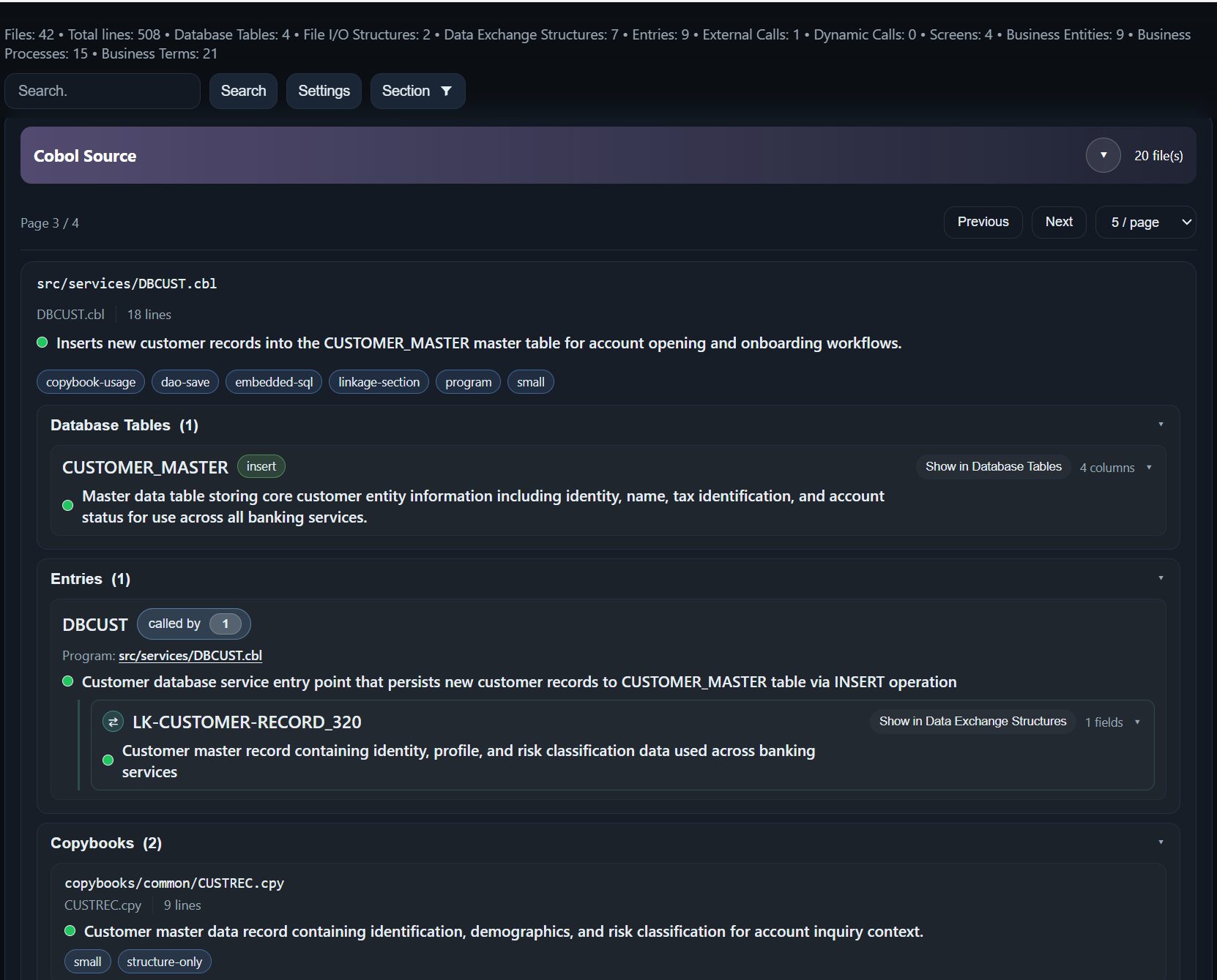
The result is a deeper and more reliable understanding of the legacy environment, with findings that are repeatable, traceable to the underlying source, and suitable for validation. Modernization decisions can therefore be based on evidence rather than inference, while AI is used to accelerate and enrich analysis without compromising accuracy or control.
Enabling Incremental Modernization with Continuous Verification
Large-scale modernization programs often carry significant business risk because they attempt to transform entire systems in a single project phase. Carbon.modernize takes a different approach by enabling incremental modernization with continuous verification.
Instead of requiring a “big bang” migration, applications can be modernized step by step while preserving operational stability. Individual components, business functions, services, or application domains can be transformed independently while maintaining compatibility with the remaining legacy landscape.
The AI capabilities supporting modernization must evolve in the same way. As project-specific knowledge increases, the analysis models, transformation rules, validation mechanisms, and AI-assisted workflows must be progressively refined to reflect the application’s technologies, architecture, business logic, and modernization objectives.
This adaptability is essential for fully realizing the value of AI in complex modernization programs. Closed or monolithic tools may perform well for predefined scenarios but can become constrained when they cannot incorporate newly discovered system knowledge, project-specific rules, expert feedback, or changing transformation requirements. Carbon.modernize enables AI capabilities to be incrementally extended and aligned with the needs of each modernization stage.
At every stage, modernization outputs are continuously verified against the original system to ensure:
- Functional equivalence
- Preservation of business rules
- Data consistency
- Process integrity
- Compliance with modernization objectives
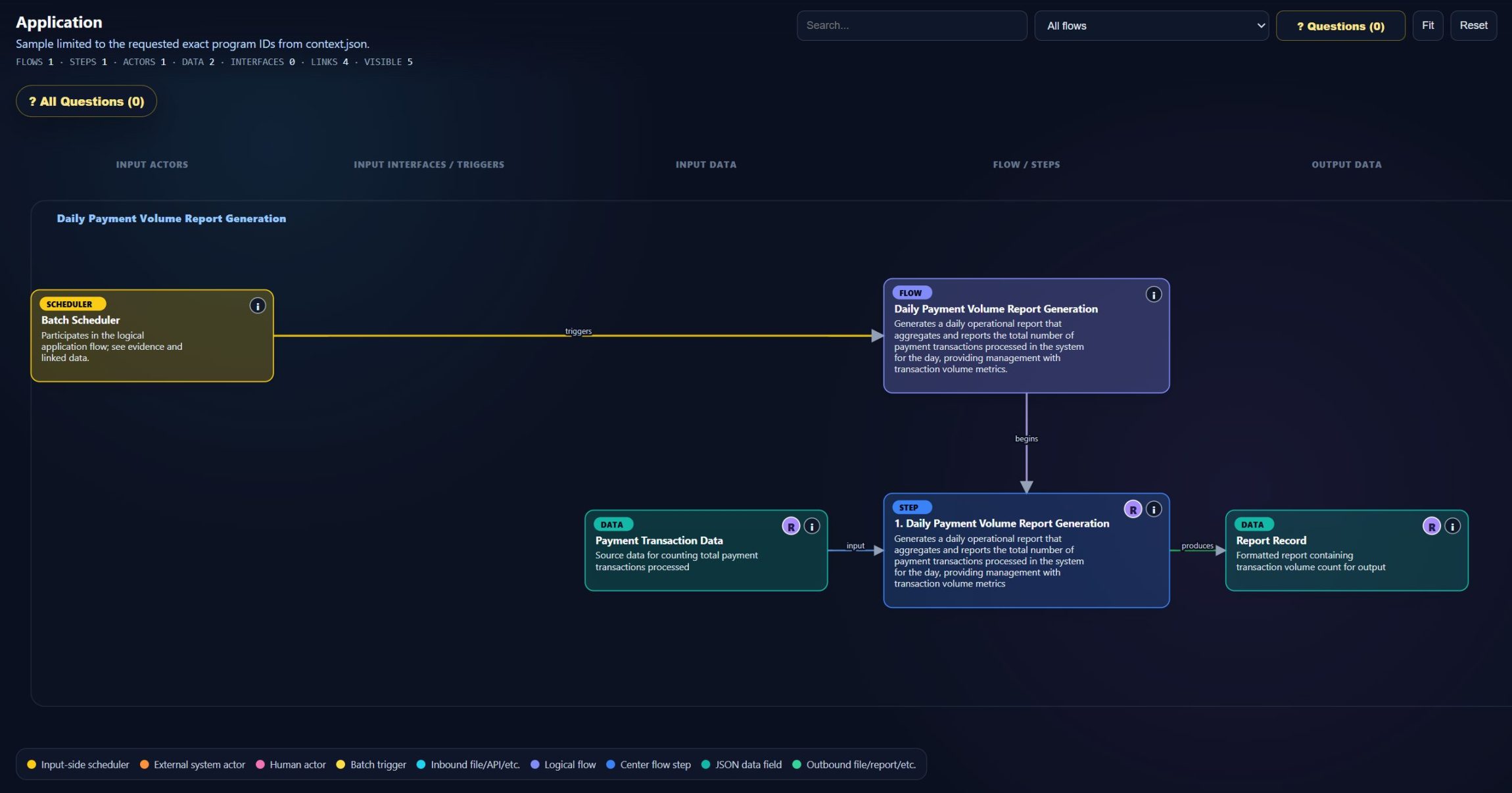
This continuous verification approach significantly reduces project risk, provides measurable progress throughout the transformation journey, and allows organizations to deliver modernization benefits earlier rather than waiting for a final cutover event.
Reducing Manual Analysis Effort Through Knowledge Reuse
Traditional modernization projects often require extensive manual analysis by highly specialized experts. A significant amount of effort is spent repeatedly discovering the same information across applications, teams, and project phases.
Carbon.modernize dramatically reduces this effort through knowledge capture and reuse.
As the platform analyzes the legacy environment, it generates structured modernization assets, including:
- Enterprise knowledge graphs
- Application dependency maps
- Business process models
- Searchable technical dictionaries
- Data lineage information
- Interface and integration catalogs
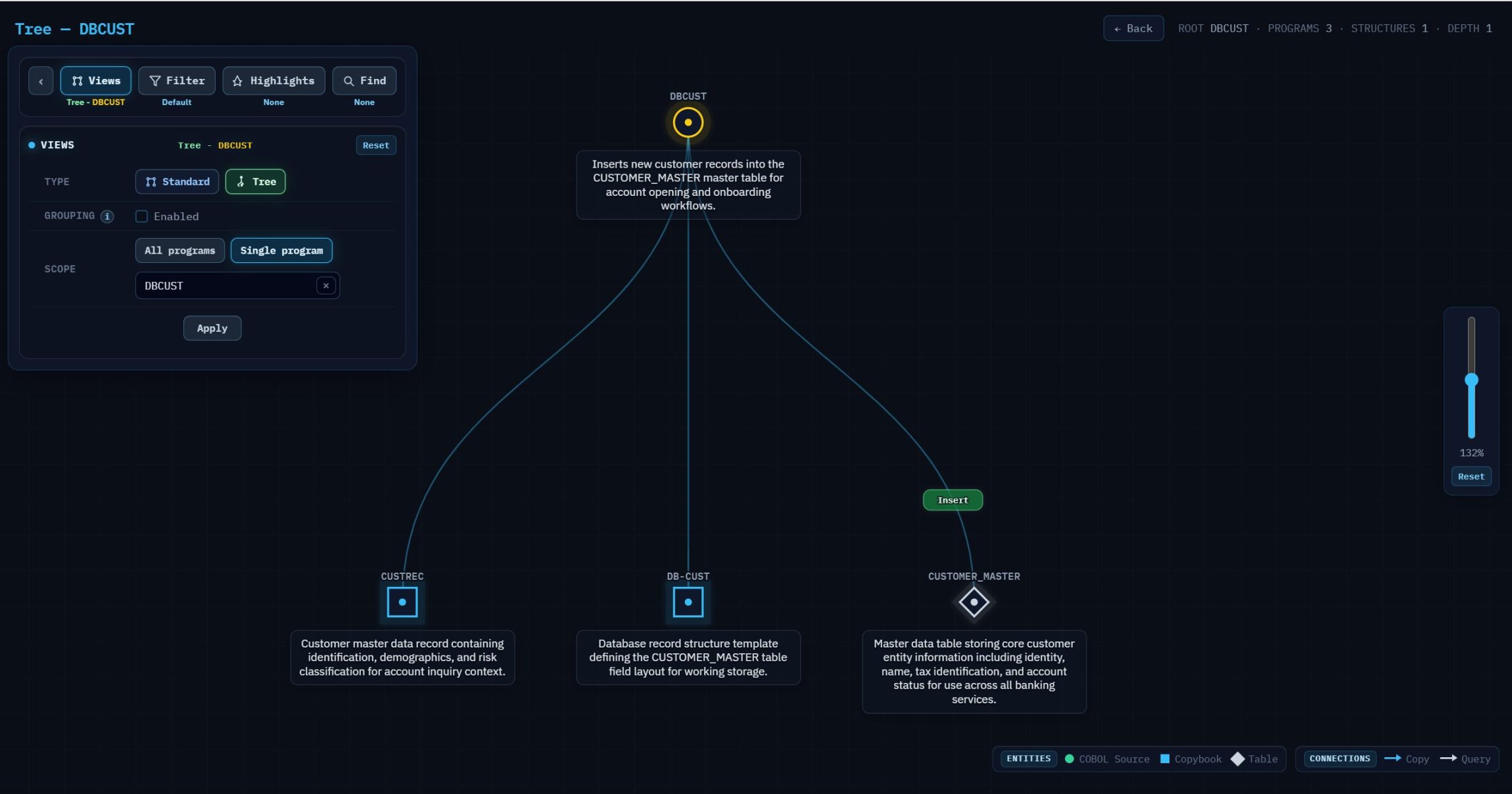
These assets create a continuously expanding knowledge repository that can be reused across the entire modernization lifecycle.
Built on this application knowledge base, live AI assistance enables teams to interactively explore the system and obtain context-specific explanations and insights on demand.
This enables teams to quickly locate application functionality, understand relationships between components, identify dependencies and impacts of change, discover business rules embedded in code and reuse insights across modernization initiatives.
A Hybrid AI Architecture
Carbon.modernize employs a hybrid AI architecture designed to balance automation, performance, privacy, and governance requirements.
On-Premises Script Engine
A key principle of the Carbon.modernize architecture is that all source code and modernization artifacts are processed by an on-premises Script Engine by default. The Script Engine executes deterministic analysis and transformation workflows, ensuring predictable, repeatable, and auditable results. As a result, customer source code, configuration files, documentation, and other sensitive assets never need to be uploaded to public cloud services or external LLM platforms.
The Script Engine itself can be generated and enhanced using either the Carbon.core platform or, where appropriate, frontier commercial LLM technologies. For scenarios that benefit from additional intelligence and automation, agentic workflows can be selectively introduced to support more advanced analysis and modernization activities.
On-Premises LLM (Carbon.core)
For use cases that require natural language understanding, knowledge extraction, code interpretation, documentation generation, or other AI-driven capabilities, Carbon.modernize leverages Carbon.core, an on-premises LLM environment.
Through custom agents, Carbon.core combines project-specific knowledge, specialized tools, deterministic workflows, and validation mechanisms to maximize the capabilities of on-premises LLMs. This enables sophisticated, multi-step modernization tasks that would not normally be expected from the underlying model alone.
Carbon.core enables organizations to apply AI to highly sensitive workloads while ensuring that all data remains within controlled customer environments and in compliance with internal security, privacy, and governance policies.
Full Protection of Privacy and Intellectual Property
Privacy and intellectual property protection are foundational principles of the Carbon.modernize methodology. We strictly adhere to customer policies regarding:
- Data privacy
- Security requirements
- Intellectual property protection
- Regulatory compliance
- AI governance
The flexibility of the Carbon.modernize architecture allows customers to determine how individual activities should be executed based on their risk profile and governance requirements.
Depending on customer preferences, specific tasks can be handled by on-premises script engine, on-premises Carbon.core LLM or selected public LLM services (where permitted).
This flexible execution model allows organizations to achieve the desired balance between security, compliance, cost, and modernization speed while retaining complete control over their sensitive assets and proprietary business logic.