
AI Governance
Take control of AI in your Enterprise. Ensure every AI interaction is policy-driven, auditable, and secure without slowing down innovation.
WHAT WE BRING TO THE TABLE
5 Pillars of AI Governance
Together, these five pillars form a complete governance layer that strengthens your AI landscape.
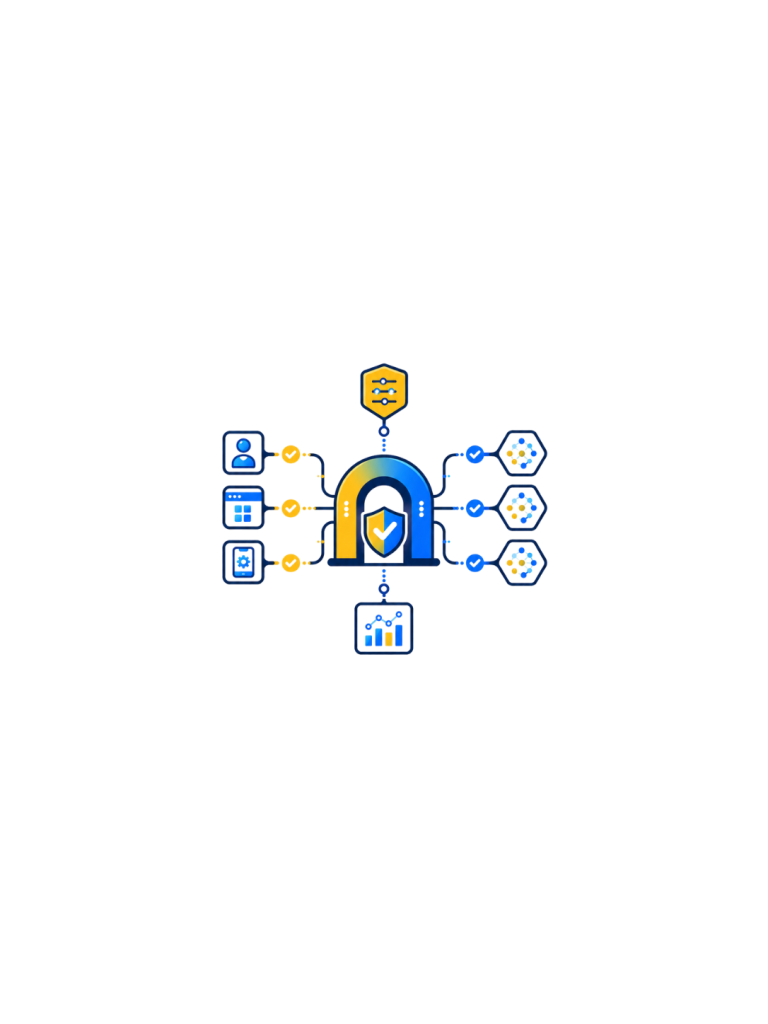
1ST PILLAR
Policy & Access Management (AI Gateway)
A centralized control plane for all AI traffic. Every request, every response, every model interaction passes through a single governed layer before reaching external AI providers. Centralized governance policies that define the rules of AI engagement across the entire organization. Who can use what, under what conditions, with what constraints.
The LLM Gateway is the architectural backbone of AI Governance. It decouples applications and teams from direct AI provider integrations, creating a single enforcement point for policies, access control, logging, and routing. Whether an employee calls ChatGPT, Claude, Gemini, or Mistral, the request flows through the Gateway, making governance automatic rather than optional.
- Unified API Layer: A single, provider-agnostic API interface for all cloud AI services. Applications integrate once and gain access to any model
- Intelligent Routing: Route requests to the best-fit model with automatic failover and load balancing
- Access Control: Enforce permissions at the gateway and determine which teams, services, or users can access which models and endpoints
- Rate Limiting & Budgets: Enforce request limits and token budgets per team, per project, or per user to prevent abuse and manage costs
- Virtual API Keys: Issue scoped API keys that map to internal teams and projects, eliminating the need to distribute provider credentials
- Prompt Management: Centralized prompt governance to ensure consistent, high-quality interactions across the organization

2ND PILLAR
AI Guardrails
Automated safety enforcement on every AI interaction protecting sensitive data, blocking threats, and ensuring AI behavior aligns with corporate policies.
Guardrails operate at two critical points: before a request reaches the AI model (input guardrails) and after the response is returned (output guardrails). This dual-layer enforcement ensures that both prompts and completions are compliant, safe, and aligned with organizational standards. Guardrails are configured centrally and enforced consistently across all AI models and providers, without requiring application-level code changes.
- PII Detection & Redaction: Automatically identify and mask personally identifiable information before it reaches external AI models, enforcing GDPR and data privacy requirements at the infrastructure level
- Prompt Injection Prevention: Detect and block malicious prompt injection attempts that could manipulate AI behavior or extract system instructions
- Content Policy Enforcement: Define allowed and disallowed topics, enforce brand guidelines, and prevent the generation of inappropriate, toxic, or off-brand content
- Output Validation: Scan AI responses for hallucinated data, sensitive information leakage, or content that violates compliance rules before it reaches end users
- Multi-Level Configuration: Apply guardrails globally across the organization, enabling flexible governance that scales with organizational complexity

3RD PILLAR
Tracing & Observability
Full end-to-end visibility into every AI interaction across the organization. From the initial user prompt through model inference to the final response.
Tracing transforms AI usage from a black box into a transparent, auditable system. Every conversation, every API call, every tool invocation is captured with complete context: who asked, what was asked, which model responded, how long it took, what it cost, and what the response contained. This creates the comprehensive audit trail that regulators require and that operations teams need for debugging, optimization, and quality assurance.
- Request-Level Tracing: Capture the full lifecycle of every AI interaction: input prompt, model parameters, output response, token usage, and latency.
- Multi-Step Pipeline Tracing: Follow complex AI workflows across multiple model calls, tool invocations, and processing steps, understanding exactly how a result was produced
- Audit Trail Generation: Immutable, timestamped records of every AI interaction
- Cost Analytics: Granular cost tracking per model, per team, per project

4TH PILLAR
Regulatory Compliance & Audit Readiness
A governance architecture built from the ground up to meet current and upcoming regulatory requirements like the EU AI Act.
The EU AI Act, entering full enforcement for high-risk AI systems in August 2026, requires organizations to implement risk management systems, maintain detailed technical documentation, ensure human oversight, and demonstrate transparency. Beyond the AI Act, GDPR restricts automated decisions with legal effects and demands data protection safeguards, while NIS2 and DORA impose additional cybersecurity and operational resilience obligations. The AI Governance platform provides the technical foundation to meet these requirements systematically rather than retroactively.

5TH PILLAR
Cost Control & Usage Analytics
Clear visibility and control over AI spend across the entire organization transforming unpredictable token-based costs into a manageable, optimized expense.
Cloud AI services are priced per token, which scales rapidly as adoption spreads across teams and departments. Without centralized visibility, AI costs can grow exponentially and unpredictably. The AI Governance platform provides real-time cost tracking, budget enforcement, and optimization insights that keep AI spend aligned with business value.
- Real-Time Cost Tracking: Monitor AI spend in real-time across providers, models, teams, and projects
- Budget Enforcement: Set hard or soft spending limits per team, project, or use case
- Model Optimization Insights: Identify opportunities to route requests to more cost-effective models
- Trend Analysis: Track usage patterns over time to forecast future AI spend, identify seasonal peaks, and plan capacity accordingly
Our approach
4-step AI Governance Framework
We follow a structured four-step approach to deliver comprehensive AI Governance.
WHAT WE BRING TO THE TABLE
Why Work With Us?
If you have any questions, we are one click away.