An AI voice agent is interesting again because the weak point has finally moved.
A few years ago, the problem was obvious: the bot was slow, the voice was stiff, and the dialogue fell apart as soon as the caller moved away from the expected phrase. Today, the first demo can sound convincing. That is progress, but it is also where projects can become misleading.
At CROZ, we have been looking closely at where this technology can actually fit into enterprise service processes. Not as a generic “AI layer” added on top of everything, but as a carefully scoped capability that needs integration, governance, monitoring, and a clear handover model from the start.
The technology is broader than contact centers. AI voice agents can support many voice-first interactions: customer support, appointment scheduling, internal service desks, field operations, citizen services, intake processes, and guided self-service. Contact centers are simply the most obvious starting point because they already have high call volumes, repeated intents, telephony infrastructure, and measurable service metrics.
In that environment, the hard part is making an AI voice agent behave predictably across noisy calls, different accents, incomplete requests, legacy systems, outdated knowledge bases, and annoyed customers. This is an integration and operations problem, not only a conversational interface.
Why does the technology feel different now?
The first real change is latency. Human conversation has a rhythm, and long pauses feel like failure. Older systems stitched together speech-to-text, a language model, and text-to-speech in a slow, sequential process. Modern stacks can stream those steps, so processing starts before the caller has fully finished speaking. Retrieval and backend calls still add delay, but the interaction feels less broken.
The second change is dialogue memory. Traditional IVR was built around one intent at a time. A modern AI voice agent can maintain context, handle requests with multiple parts, ask for missing information, and recover when the caller changes direction. It still needs boundaries, but the conversation does not have to be a rigid tree.
The third change is grounding. A contact center bot should not improvise policy, pricing, account rules, or support answers. Retrieval-augmented generation, often shortened to RAG, allows the AI voice agent to look up information from approved sources during the call. The knowledge base still has to be clean, current, searchable, and fast enough not to destroy the conversation timing.
What a useful AI voice agent needs to handle
A useful AI voice agent needs more than a natural voice. It needs turn-taking, interruption handling, fallback rules, confidence thresholds, routing logic, transcripts, monitoring, and a clear escalation path. If it is connected to business systems, it also needs authentication flows, permission checks, logging, and failure handling for moments when an API is slow or unavailable.
Human handover is part of the design, not a backup plan. There will always be callers who ask for a person immediately, and cases where automation should stop. The human agent should receive the useful context: what the caller wanted, what was asked, what was answered, and why the AI voice agent escalated. Without that, the customer spends time with automation, then repeats the same story to a person.
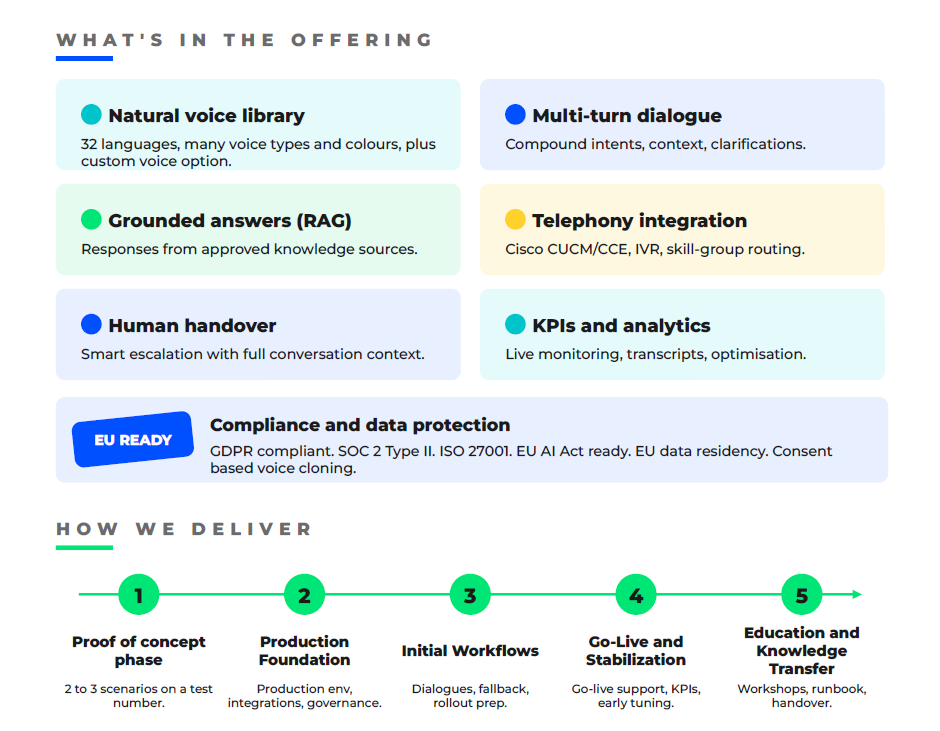
At CROZ, this is how we look at conversational voicebot scenarios: as a set of practical building blocks that need to be tested together, from multi-turn dialogue and grounded answers to telephony integration, human handover, monitoring, KPIs, and rollout governance.
Where to start
The safest first use cases are boring on purpose: appointment scheduling, request status, order status, routing, structured intake, password reset support, or basic questions answered from an approved source. They are common, measurable, and usually low risk. That makes them good PoC candidates because the team can see whether the AI voice agent resolves the issue, not just whether it sounds impressive.
The first use case should not be a complex complaint, fraud case, medical advice, credit decision, insurance pricing, or anything where a wrong answer creates legal or financial exposure. Those areas may use AI later, often as agent assist or intake support, but they need stronger controls and human oversight.
Compliance is not a project phase at the end.
For EU organizations, voice data must be handled carefully from the earliest design discussions. Voice recordings are personal data, and some use cases can cross into biometric processing. That affects consent, retention, deletion, access control, data residency, and transparency. This is why voice AI should be treated as part of a broader enterprise AI governance strategy, not as an isolated automation tool.
Governance also means deciding what the bot is not allowed to do. Which knowledge sources are trusted? Which topics require escalation? How are transcripts reviewed? Who fixes a wrong answer? How often are flows and sources updated? These questions decide whether the system can survive outside a pilot.
What a PoC should prove
A realistic PoC should start with two or three scenarios on a test number, not a full contact center redesign. The team should validate the call flow, RAG quality, telephony integration, handover, monitoring, and basic KPIs before any production rollout. It should also test real-world conditions: background noise, impatient callers, unclear phrasing, repeated questions, and backend delays.
The metrics need to reward solved problems. Deflection alone is weak because a customer can be “contained” and still call back angry ten minutes later. Better signals include first-contact resolution, repeat-contact rate, escalation rate, average handling time, latency, transcript quality, and incomplete or incorrect answers.
The best operating model is hybrid. An AI voice agent should take repetitive tier-one volume where the path is clear. Human agents should own complex, emotional, regulated, or high-value conversations. When that split is designed well, the AI voice agent does the narrow job automation is good at and steps aside when a person is the better interface.
At CROZ, this is the direction we are exploring with conversational voicebot scenarios: practical use cases, clear boundaries, reliable handover, and a PoC-first approach. The best place to start is one concrete workflow worth testing.